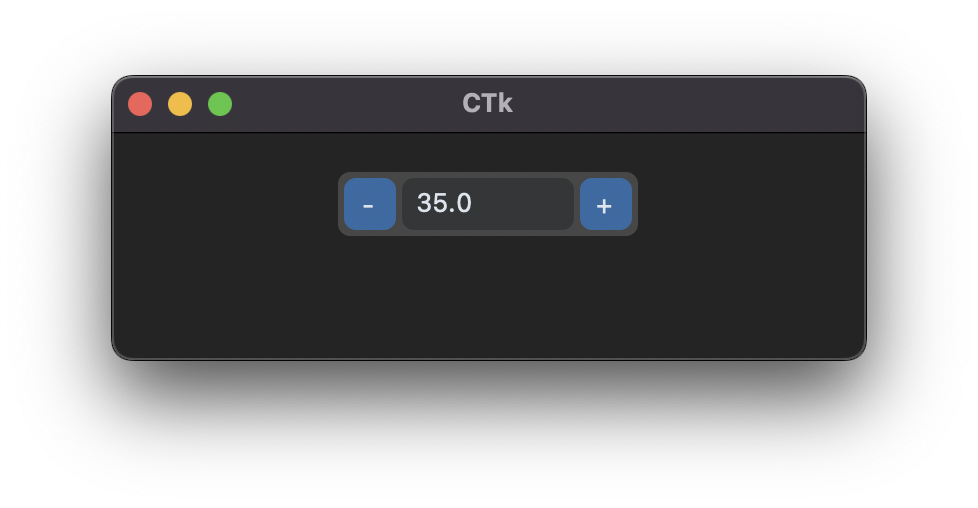
1. Create Spinbox
Create widgets from frame
If you want to create new widgets by yourself, because you need something that's not implemented with Customtkinter, you can easily do this. In the following I created a Spinbox based on float values.
First you create a new class, that inherits from customtkinter.CTkFrame:
import customtkinter

class WidgetName(customtkinter.CTkFrame):
    def __init__(self, *args,
                 width: int = 100,
                 height: int = 32,
                 **kwargs):
        super().__init__(*args, width=width, height=height, **kwargs)
By doing this, you already have a widget that has a default size given by the default values of the attributes width and height. And it also supports all attributes of a CTkFrame like fg_color and corner_radius.
Create spinbox from frame
A simple implementation af a float based Spinbox could look like the following:
class FloatSpinbox(customtkinter.CTkFrame):
    def __init__(self, *args,
                 width: int = 100,
                 height: int = 32,
                 step_size: Union[int, float] = 1,
                 command: Callable = None,
                 **kwargs):
        super().__init__(*args, width=width, height=height, **kwargs)

        self.step_size = step_size
        self.command = command

        self.configure(fg_color=("gray78", "gray28"))  # set frame color

        self.grid_columnconfigure((0, 2), weight=0)  # buttons don't expand
        self.grid_columnconfigure(1, weight=1)  # entry expands

        self.subtract_button = customtkinter.CTkButton(self, text="-", width=height-6, height=height-6,
                                                       command=self.subtract_button_callback)
        self.subtract_button.grid(row=0, column=0, padx=(3, 0), pady=3)

        self.entry = customtkinter.CTkEntry(self, width=width-(2*height), height=height-6, border_width=0)
        self.entry.grid(row=0, column=1, columnspan=1, padx=3, pady=3, sticky="ew")

        self.add_button = customtkinter.CTkButton(self, text="+", width=height-6, height=height-6,
                                                  command=self.add_button_callback)
        self.add_button.grid(row=0, column=2, padx=(0, 3), pady=3)

        # default value
        self.entry.insert(0, "0.0")

    def add_button_callback(self):
        if self.command is not None:
            self.command()
        try:
            value = float(self.entry.get()) + self.step_size
            self.entry.delete(0, "end")
            self.entry.insert(0, value)
        except ValueError:
            return

    def subtract_button_callback(self):
        if self.command is not None:
            self.command()
        try:
            value = float(self.entry.get()) - self.step_size
            self.entry.delete(0, "end")
            self.entry.insert(0, value)
        except ValueError:
            return

    def get(self) -> Union[float, None]:
        try:
            return float(self.entry.get())
        except ValueError:
            return None

    def set(self, value: float):
        self.entry.delete(0, "end")
        self.entry.insert(0, str(float(value)))
Of course you could add a configure method or more attributes to configure the colors in the init method.
But with the above implementation you can use the spin box like the following:
app = customtkinter.CTk()

spinbox_1 = FloatSpinbox(app, width=150, step_size=3)
spinbox_1.pack(padx=20, pady=20)

spinbox_1.set(35)
print(spinbox_1.get())

app.mainloop()